
Business Law
Transition Services Agreement: Key Terms for Ontario M&A
Most acquisitions of a division or business unit close before the buyer can run every function on its own. Payroll still runs through the seller's system, custo
Read Article →Insights & Resources
Practical insights, strategic perspectives, and real-world lessons from corporate transactions and tax planning engagements.
Most acquisitions of a division or business unit close before the buyer can run every function on its own. Payroll still runs through the seller's system, custo
Read Article →
A material adverse change clause decides who carries the risk if a business deteriorates between signing and closing. In Ontario, a buyer can refuse to close on
Read Article →
When an Ontario business sells on a debt free cash free basis, the buyer prices the operating business as if it carried no borrowings and no surplus cash. The s
Read Article →
An intercreditor agreement is a contract between two or more lenders to the same borrower that sets out who gets paid first, whose security ranks ahead, and who
Read Article →
A change of control clause gives the other party to a contract specific rights when ownership or control of your company shifts, even though the company that si
Read Article →
Most Ontario business owners deal with a commercial lease assignment at a high-stakes moment: a sale, a restructuring, or an exit. An assignment transfers the t
Read Article →
Vendor take back financing lets a seller accept part of the purchase price over time, so a buyer can close a business purchase that bank loans and buyer cash ca
Read Article →
An escrow agreement is a contract under which a neutral holder keeps money, shares, or documents until conditions the parties have agreed in writing are met. In
Read Article →
An indemnification clause is often the provision that decides who pays when a problem surfaces after a business changes hands. Ontario buyers want assurance tha
Read Article →
Every Ontario business acquisition ends with a purchase agreement, and the clauses that do the most work after closing are the seller's statements about the bus
Read Article →
A locked box mechanism fixes the purchase price in a mergers and acquisitions deal by reference to a balance sheet dated before signing. The buyer takes on the
Read Article →
A working capital adjustment changes the purchase price after closing so that the buyer pays for the operating liquidity it receives. The working capital adjust
Read Article →
An earnout is a part of the purchase price in a business acquisition that the buyer pays only if the business hits agreed performance targets after closing. An
Read Article →
Selling or buying a private company in Ontario is a legal and tax project as much as a commercial one. The structure you choose, the way risk is allocated in th
Read Article →
A corporate tax lawyer in Toronto helps you make growth, ownership, and exit decisions in an order that keeps more value in the business and in your hands. The
Read Article →
Most GST/HST errors cost far less to fix before the Canada Revenue Agency (CRA) finds them. Through the voluntary disclosures program, an unprompted applicant n
Read Article →
A CRA letter about missing receipts or unreported crypto is a solvable problem when you respond with organized evidence and a clear plan. The Canada Revenue Age
Read Article →
Unreported rental income draws Canada Revenue Agency (CRA) attention because it leaves a paper trail: land title records, bank deposits, platform payouts and te
Read Article →
A CRA audit of your small business can move quickly from routine document requests to a proposed reassessment. That is especially true when the auditor finds fo
Read Article →
You can still fix unfiled tax returns in Canada after the Canada Revenue Agency (CRA) has estimated your tax, but your deadlines start running from the date on
Read Article →
Most Canadian tax returns can be reassessed for three years after the Canada Revenue Agency (CRA) sends the original notice of assessment, but that period stret
Read Article →
If you disagree with the audit findings of the Canada Revenue Agency (CRA), you have two main windows to act. The first opens before the audit closes, when the
Read Article →
Many business owners only discover a past tax problem after a letter from the Canada Revenue Agency (CRA) arrives. The right response depends on what the letter
Read Article →
When you share sensitive tax information with a lawyer for the purpose of obtaining legal advice, that communication is protected from the Canada Revenue Agency
Read Article →
Correcting a past tax filing with the Canada Revenue Agency (CRA) comes down to one decision made before anything is filed: fix the error quietly through a reas
Read Article →
The documents the Canada Revenue Agency (CRA) asks for during an audit are the records behind every number you filed. Those records show your tax obligations we
Read Article →
A CRA audit puts two questions on the table at once: whether your numbers hold up, and whether your legal position holds up. For most Ontario businesses facing
Read Article →
Every dollar you earn in Canada is reportable unless a specific rule excludes it, and the Canada Revenue Agency (CRA) now has more ways than ever to spot income
Read Article →
A CRA audit letter means the Canada Revenue Agency has selected one or more of your returns for a closer look. It starts a process with fixed deadlines and reco
Read Article →
A section 85 rollover allows you to transfer eligible property to a taxable Canadian corporation and defer some or all of the immediate income tax by jointly el
Read Article →
At Beganyi Professional Corporation, we provide corporate and tax law services for Toronto entrepreneurs and growing Ontario businesses, handling corporate tran
Read Article →
A health profession corporation differs from a standard business corporation. It is governed by two separate sets of rules, both of which apply at all times.
Read Article →
Discover why 73% of Ontario business owners lack a succession plan and learn how strategic business succession planning and a tax lawyer protect your enterprise value.
Read Article →
After agreeing on a price, the buyer’s lawyer may send an extensive document request. As a buyer, you may notice discrepancies in the financials.
Read Article →
Aligning tax and legal strategy helps Ontario entrepreneurs protect assets, reduce liability, and create long-term business efficiency.
Read Article →Ontario entrepreneurs can protect value and minimize tax by planning early for business sales and corporate reorganizations.
Read Article →
Ontario entrepreneurs can save up to $1M in tax on a business sale using the lifetime capital gains exemption with proper legal structuring.
Read Article →
Estate freezes help Ontario business owners transfer wealth, minimize tax, and plan for smooth family business succession.
Read Article →
Ontario holding companies allow entrepreneurs to protect assets, defer taxes, and manage growth through smart legal structuring.
Read Article →
Ontario businesses can ensure merger success through strong integration planning, culture alignment, and effective leadership.
Read Article →
Ontario entrepreneurs use Letters of Intent to define deal terms and guide M&A negotiations with clarity and strategic focus.
Read Article →
Merging two Ontario businesses requires strong legal planning, due diligence, and integration strategy to protect value and ensure success.
Read Article →
Buying a business in Ontario requires legal, tax, and due diligence planning to protect your investment and ensure a smooth transition.
Read Article →
Ontario business owners can boost valuation and reduce risk by preparing early for sale with strong legal, tax, and due diligence planning.
Read Article →
Tax-driven reorganizations help Ontario entrepreneurs unlock value, reduce tax exposure, and position their businesses for future growth.
Read Article →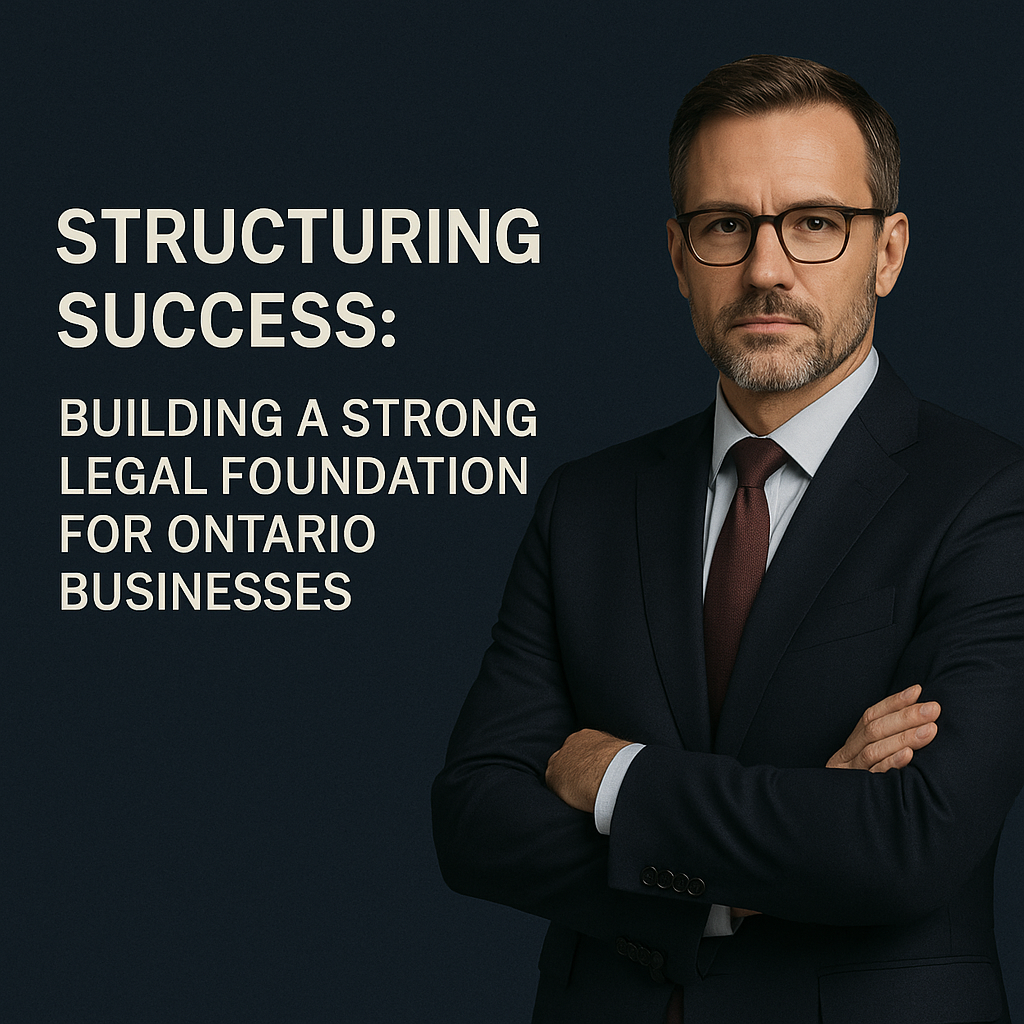
he right legal structure protects Ontario entrepreneurs, reduces risk, and positions your business for sustainable growth.
Read Article →
Strong governance and informed directors help Ontario businesses manage risk, attract investors, and drive ethical long-term growth.
Read Article →
A shareholder agreement defines control, protects ownership, and prevents costly disputes between Ontario business partners.
Read Article →Schedule a consultation to discuss how these insights can be tailored to your specific situation.
Book a Consultation